

Your child may score well in an examination yet struggle to make decisions, explain ideas or take responsibility. That gap becomes important when you are considering admission to an English medium school, because the curriculum will shape far more than report-card marks.
The 3C curriculum addresses this gap through three connected pillars: character, competence and content. It helps children understand subjects, apply knowledge and grow into responsible individuals.
At a Glance: About 3C Curriculum
This blog explains how the 3C Curriculum shapes a child’s learning through Character, Competence and Content. It covers academic growth, practical skills, assessment methods and key factors to consider before admission to an English medium school in Kolkata.
What Is the 3C Curriculum, and Why Are Schools Using It?
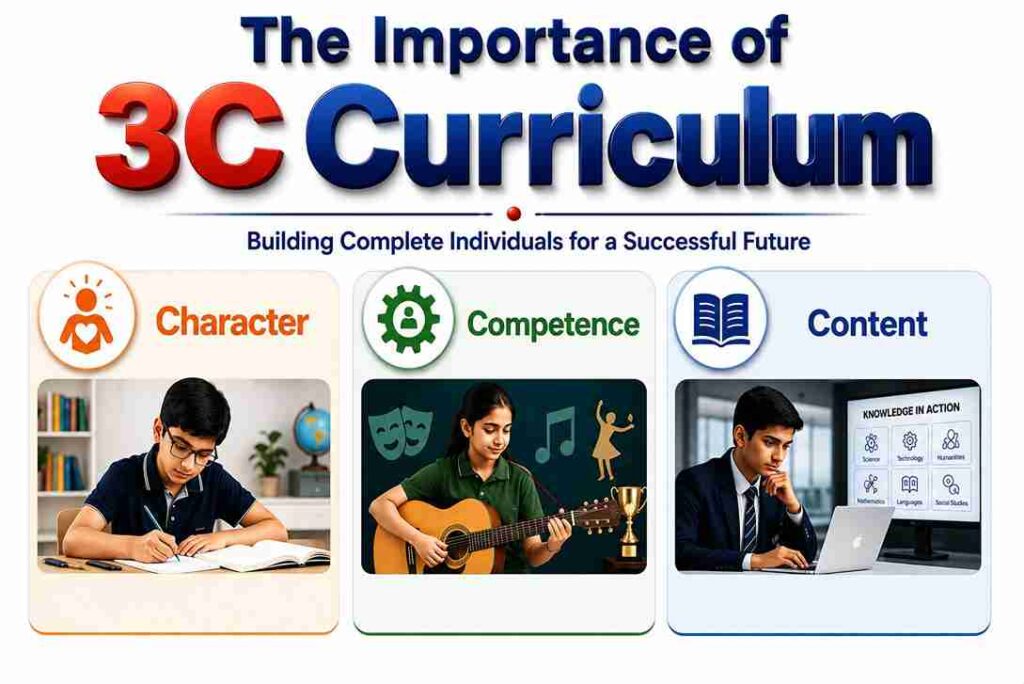
The character competence content curriculum brings academic learning, practical ability and personal development into one framework.
- Content gives children subject knowledge.
- Competence helps them apply that knowledge.
- Character guides how they behave, decide and work with others. Together, these three areas support a holistic learning approach.
Schools are using the 3C curriculum because modern education aims for children to develop communication, problem-solving, moral reasoning, collaboration and future-ready skills.
Character: Is My Child Becoming Responsible, Respectful and Self-Aware?
- Character development in students reflects in how children speak to classmates, respond to mistakes, complete responsibilities and make choices.
- Through values-based education, children learn respect, honesty, self-awareness and personal responsibility in school.
- Teachers may use stories, classroom situations, group tasks or reflection to help students understand consequences.
Example of ethical decision-making and trust: when a child admits a mistake instead of hiding it.
Competence: Can My Child Apply Skills Confidently in Real-World Situations?
- Competence-based learning for students focuses on knowledge application skills.
- A child may know how percentages work, but competence becomes visible when they calculate a discount, compare prices or explain the method clearly.
- This form of skill-based education develops communication, teamwork, critical thinking and problem-solving. It also supports competency-based progression, where learning is judged by what a child can demonstrate.
Content: Is My Child Building Strong and Lasting Subject Knowledge?
- Modern learning does not make content less important. In fact, competence cannot grow without strong subject mastery in school.
- The difference lies in how children learn content. Instead of memorising isolated answers, they understand concepts, connect ideas and use knowledge in different situations.
- Content-rich learning benefits students because strong foundations make higher classes easier.
Once these three pillars work together, the next parental concern naturally arises: what happens to examinations?
Does the 3C Curriculum Ignore Examinations or Academic Rigour?
No. Our exam-focused curriculum for Classes IX and X does not replace textbooks, tests or academic discipline. It changes how students prepare for them.
The aim is to combine conceptual understanding with regular practice, written work and clear learning outcomes.
How Are Character and Competence Developed Alongside Strong Content Knowledge?
A well-designed lesson can develop all three areas together.
Suppose students study water conservation. They learn scientific content about water sources and usage. They build competence by measuring household consumption or preparing a presentation. They develop character by reflecting on waste and responsibility.
Can This Approach Prepare My Child for Examinations?
Yes, when implemented well.
Exams increasingly test conceptual understanding, interpretation and real-world application, not just memory. Activity-based learning and academics can work together, as projects and discussions build clarity while revision, worksheets and tests improve recall and writing speed. The real choice is not traditional vs modern learning, but finding the right balance between both.
How Are Character, Competence and Content Assessed?
Student assessment in modern curriculum uses multiple methods. Content is measured through tests and assignments, competence through projects, presentations and problem-solving, while character is observed through responsibility, teamwork and reflection. Parents should receive specific feedback on how clearly their child understands, participates and responds to guidance.
My Child Is Shy—Will the 3C Model Put Them Under Pressure?
Many parents worry that activity-based classrooms may favour confident speakers. However, participation is not limited to speaking aloud. The nursery to Class IV learning approach focuses on helping children participate at their own pace and build confidence through guided activities, discussions and hands-on learning.
Does a Child Need to Be Outspoken to Develop Character and Competence?
Quiet children can think deeply, observe and contribute meaningfully.
A child may show competence through written work, research, drawing, experiments or one-to-one discussion. Character may appear through reliability, empathy and thoughtful behaviour rather than public leadership.
How Do Teachers Support Quieter or Hesitant Learners?
Teachers can begin with pair work before moving to larger groups. They may allow written responses, assign clear roles or give children preparation time before speaking.
A supportive classroom builds confidence gradually. It does not force every child to perform in the same way.
How Do Character, Competence and Content Help My Child Beyond the Classroom?

Character builds responsibility and ethical decision-making, competence develops communication, adaptability and knowledge application skills, while content supports informed choices. Together, the 3C curriculum benefits for children extend beyond school through stronger real-world application in everyday life, higher studies and future work.
What Does a 3C Classroom Actually Look Like?
The difference appears in daily learning.
1. Instead of Memorising Values, Students Practise Them Through Everyday Situations
Students may discuss fairness during group work, take responsibility for classroom tasks or reflect on how their actions affect others.
2. Rather than Memorising Answers, Students Apply Knowledge to Demonstrate Competence
With activity-based classrooms for Classes V to VIII, children may conduct experiments, solve real-life problems, create models or explain their reasoning.
3. Instead of Learning Isolated Facts, Students Connect Ideas and Understand Subjects More Deeply
A topic such as food may connect science, mathematics, health, geography and language. This student-centred learning approach helps children see how subjects relate to the world around them.
How Will I Know Whether My Child Is Actually Developing the 3Cs?
Progress often appears in small everyday changes.
1. Signs of Growing Responsibility and Self-Awareness
Your child may begin completing tasks without repeated reminders, admitting mistakes or considering how actions affect others.
2. Instances of Increasing Confidence and Competence
You may notice better communication, independent problem-solving or greater willingness to try unfamiliar tasks.
3. Signs of Deeper Subject Understanding
Your child may explain concepts in their own words, connect topics or answer questions that are framed differently.
What Questions Should Parents Ask Before Choosing a School With a 3C Curriculum?
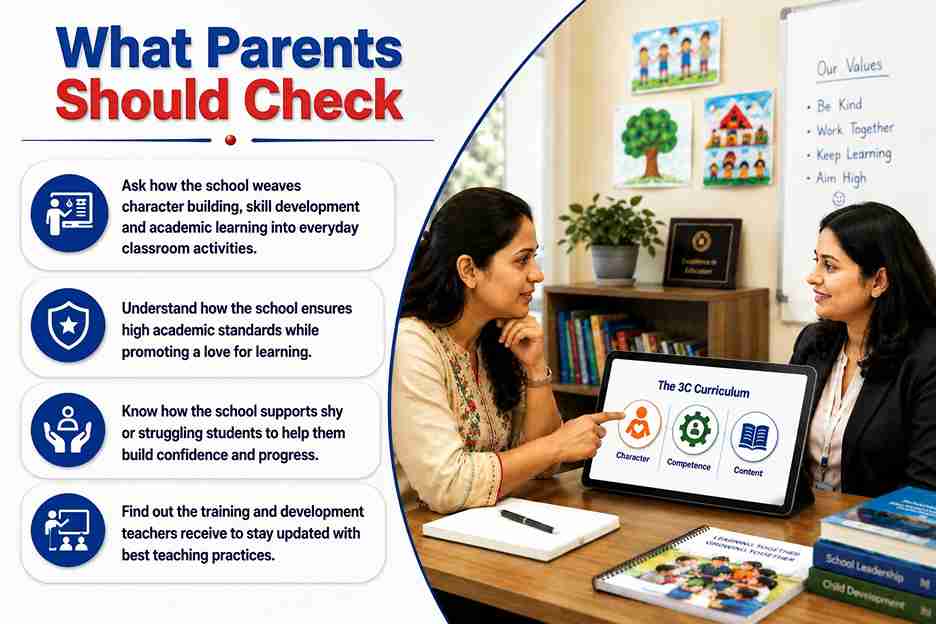
While considering admission to an English medium school in Kolkata, ask these questions:
- How are character, competence, and content included in daily lessons?
- How does the school maintain academic rigour?
- How are shy or struggling students supported?
- What training do teachers receive?
- How are projects and group work assessed individually?
- How does the school prepare children for examinations?
- How is progress communicated to parents?
How Can Parents Support the 3Cs at Home Without Adding Extra Homework?
- Give your child small responsibilities: ask them to explain their answers and involve them in simple decisions such as shopping, journey planning or household problem-solving.
- Encourage reading, curiosity and independent project work to build responsibility, practical thinking and confidence.
Is the 3C Curriculum Right for Every Child?
- The framework can support different learners, but implementation matters.
- Some children need more repetition, written practice or individual guidance. Others may need extra time before participating. A good school adjusts support without lowering expectations.
- The 3C label alone does not guarantee quality. Teacher training, classroom size, assessment methods and academic planning determine whether the approach works well.
The 3C Curriculum Prepares Children to Be, Do and Know—Not Just Remember
The right school should prepare your child not only to remember lessons, but also to apply knowledge, make responsible choices and face future challenges with confidence.
Before deciding on admission to an English medium school in Kolkata, look beyond the curriculum label and check how the school develops character, competence and content through daily teaching. Considering admission for your little one?
Get in touch now!
Here’s What People Also Ask For
1) Will the 3C curriculum reduce the importance of my child’s marks?
No. Your child will still prepare for exams, complete written work and revise regularly. The 3C Curriculum strengthens performance by building conceptual understanding and knowledge application skills beyond memorisation.
2) Will my child still receive homework under the 3C Curriculum?
Yes. Your child may still receive homework, but it should ideally reinforce classroom learning. It may include written practice, reading, observation, problem-solving or short application-based tasks rather than repetitive copying.
3) Can the 3C Curriculum prepare my child for higher classes?
Yes. Strong content knowledge, independent thinking and practical competence help your child handle complex subjects and application-based questions with greater confidence.
4) How will I know whether my child’s character is being assessed fairly?
You should receive specific feedback on your child’s responsibility, teamwork, self-awareness and progress, without teachers placing fixed labels on their personality.