
Middle school is a stage of curiosity, questions, and “why?” moments. It’s also the perfect time for students to pick up skills that will shape their future, like coding, AI, and financial skills.
At this age, children are curious, adaptable, and eager to explore concepts that prepare them for a technology-driven world. Integrating these skills into the curriculum ensures learning is practical, engaging, and relevant to real-life applications.
Nurturing Curiosity with AI Literacy
Artificial Intelligence is becoming part of daily life, influencing industries, apps, and decisions. Introducing AI early helps students develop critical thinking, creativity, and digital responsibility, laying the foundation for future problem-solving.
How AI Shapes Everyday Life
Students explore how machines “think,” make decisions, and process data. Understanding AI in context builds analytical skills and logical reasoning while making abstract concepts tangible.
Bringing AI to Life with Projects
Hands-on projects such as chatbots, AI-driven games, and predictive models allow students to see concepts in action. These exercises foster curiosity, engagement, and innovation.
Benefits of Learning AI
| Benefit | Real-World Example |
| Problem-solving | Using AI to optimise schedules and classroom activities |
| Creativity | Designing AI-powered apps or games |
| Digital Awareness | Understanding ethical data use and responsible AI practices |
By combining theory with practical application, students develop essential skills that prepare them for a technology-driven future.
Developing Computational Thinking Skills
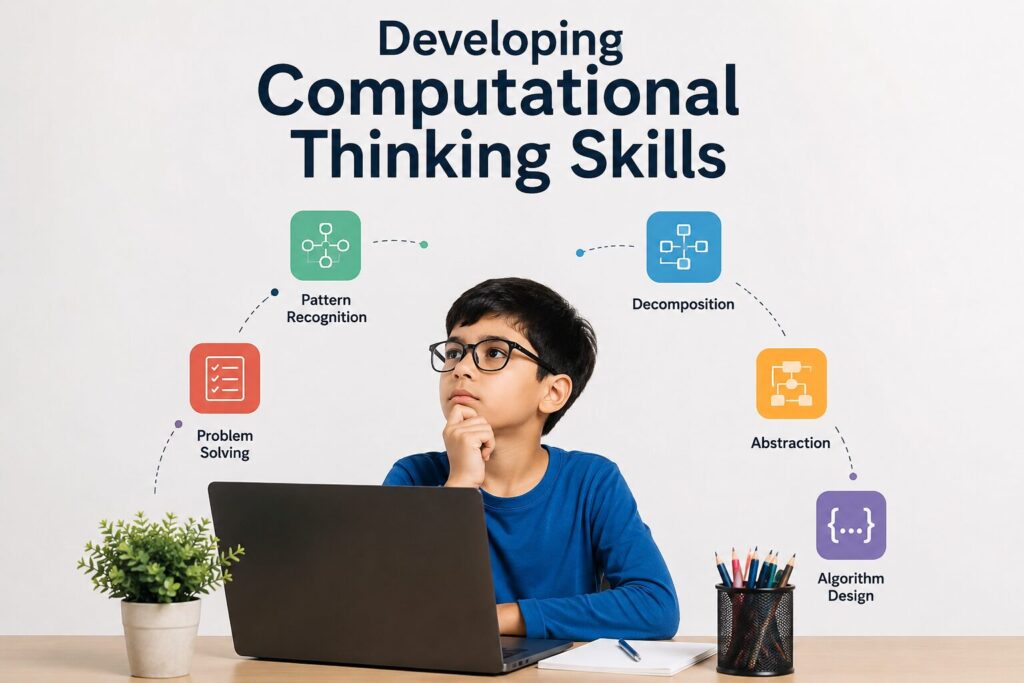
Computational thinking teaches students to break problems into parts, recognise patterns, and develop logical solutions. These skills are critical for academic and professional growth.
Computational Thinking in Action
| Skill Component | Classroom Activity | Learning Outcome |
| Decomposition | Breaking coding projects into smaller steps | Students manage complex tasks more effectively and work in an organized manner |
| Pattern Recognition | Analysing data from experiments and identifying similarities | Students recognize trends, make connections, and predict outcomes accurately |
| Algorithmic Thinking | Writing step-by-step instructions for games, projects, or coding tasks | Students develop logical planning skills and execute tasks systematically |
| Problem Solving | Tackling real-world challenges through puzzles, coding activities, and group projects | Students build critical thinking skills and learn to find effective solutions independently |
| Abstraction | Focusing on essential information while ignoring unnecessary details in projects | Students simplify complex concepts and create efficient models or solutions |
Breaking Down Problems Systematically
For students in CBSE Classes 6–8, computational thinking skills help them tackle complex problems by breaking them into smaller, manageable steps.
By practising decomposition, pattern recognition, and algorithmic planning, students learn to approach tasks with confidence and structure. Mastering this approach ensures learners can handle challenges efficiently, fostering resilience, creativity, and a mindset geared toward practical solutions and future-ready thinking.
Classroom Activities That Enhance Logic
Students develop computational thinking through hands-on exercises, coding challenges, and collaborative problem-solving tasks. Activities include debugging simple programs, designing algorithms, or analysing patterns in science and math projects.
By engaging in structured yet interactive activities, students gain confidence in applying analytical skills to real-world scenarios.
At Bodhi Bhavan, a CBSE school in Kolkata, children learn through guided activities. This helps them build logical thinking, creativity, and problem-solving confidence early.
Early Coding Education in Schools
Early coding education teaches logic, resilience, and creativity. It is an essential part of preparing students for high school and future careers in technology.
Coding Beyond Programming
Students develop problem-solving and logical reasoning by debugging code, building programs, and collaborating on projects. These exercises teach perseverance and structured thinking.
Tools and Platforms for Middle School
Middle schoolers experiment with block coding, Python, and microcontrollers. Hands-on practice turns abstract concepts into tangible learning, boosting confidence and engagement.
Advantages of Early Coding
- Students gain confidence in problem-solving.
- Collaborative coding projects enhance teamwork and communication.
- Early coding experience prepares learners for advanced computer science in high school.
Financial Literacy for Middle School Students
Understanding money, budgeting, and investment is crucial for children. Learning these skills early fosters responsibility, decision-making, and long-term planning.
Learning Money Management
Students practise budgeting, saving, and tracking expenses through activities and digital simulations. This strengthens financial intelligence and life skills.
Classroom Simulations and Interactive Games
Activities like planning a school event budget or participating in virtual investment exercises make financial literacy practical and engaging.
Financial Skills Through Everyday Activities
| Skill | Activity | Learning Outcome |
| Budgeting | Planning a class event with a fixed budget | Students learn responsible resource management |
| Saving | Allocating allowance for long-term goals | Students develop patience and planning |
| Investment Basics | Simulating small investments or virtual stocks | Students understand financial growth and risk |
Aligning with NEP 2020
The NEP 2020 skill-based learning framework focuses on experiential, hands-on learning, enabling students to apply theoretical knowledge in practical contexts. This approach develops creativity, adaptability, and problem-solving skills.
Project-Based Learning (PBL)
Students engage in building models, conducting experiments, and presenting their findings. PBL strengthens analytical thinking, collaboration, and critical reasoning.
Collaborative and Interdisciplinary Learning
By integrating coding, AI, math, and science, learners discover real-world connections. Cross-disciplinary projects reinforce understanding, encourage teamwork, and prepare students for future academic and professional challenges. This framework ensures practical skill development and future-readiness.
The NEP 2020 skill-based curriculum at Bodhi Bhavans gives students a head start in innovation. As a top CBSE school in Kolkata, it prepares learners for future-ready challenges.
Building Future-Proof Skills for Students
Equipping learners with modern competencies ensures they are ready for unpredictable future careers.
Confidence and Innovation
Students develop creativity, analytical thinking, and innovation. These abilities help them adapt to rapidly evolving technologies and emerging career opportunities, fostering problem-solving and critical reasoning.
Ethical Digital Citizenship
Understanding online responsibility is essential. Learning AI literacy and digital citizenship teaches students to navigate digital spaces safely, ethically, and productively, ensuring they become informed, responsible, and future-ready learners prepared for academic and professional challenges.
Project-Based Learning in Technology Education
Project-based learning allows students to apply their knowledge in practical, real-world scenarios.
By working on hands-on projects, learners consolidate coding, AI, and financial literacy concepts while gaining problem-solving and analytical skills. This approach transforms abstract ideas into tangible outcomes and fosters deep understanding.
Integrating Coding, AI, and Finance
Students see the interplay between multiple skills through engaging projects. Examples include:
- Designing apps that solve real-life school or community problems
- Simulating AI models to predict outcomes in experiments or games
- Planning projects that incorporate budgeting, coding logic, and data analysis
Encouraging Curiosity and Teamwork
Collaborative projects promote curiosity, critical thinking, and creativity. Students:
- Learn from peers and explore diverse solutions
- Develop strong communication and teamwork skills
- Build resilience by iterating on their projects and testing ideas
Through these experiences, learners gain practical skills while becoming confident, innovative, and future-ready.
Problem-Solving and Logical Reasoning
Problem-solving is a vital skill for middle school students. Through practice, students develop problem-solving and logical reasoning that help in academics and real-life scenarios.
Hands-On Problem Challenges
| Scenario | How Students Approach It | Skill Developed |
| Debugging code | Identify the error and test solutions | Analytical thinking |
| Planning a school event | Allocate resources and organise tasks efficiently | Resource management |
| AI simulation | Train models and test predictions | Logical reasoning |
Turning Challenges into Opportunities
By practising problem-solving exercises, students gain confidence and resilience. They learn that challenges are not obstacles; they’re opportunities to think creatively, collaborate, and apply knowledge in practical ways.
Fostering Creativity, Problem-Solving, and Digital Literacy
Early exposure to AI, coding, computational thinking, and financial literacy equips middle school students with essential future-ready skills. Project-based learning, teamwork, and ethical digital practices cultivate problem-solving, creativity, and confidence, ensuring learners thrive academically and in real-world scenarios.
Empower your middle schooler with future-ready skills—enroll now at Bodhi Bhavans.
Call +91 9830062937 for enquiries.
People Also Ask
How can coding skills benefit my child outside the classroom?
Coding improves logical thinking, problem-solving, and creativity. It also equips students to tackle real-life challenges, design projects, and develop confidence in using technology effectively.
What are some practical activities to develop financial literacy for middle schoolers?
Students can practice budgeting class events, simulate investments, or track personal allowances. These activities teach responsible money management and decision-making in a fun, hands-on way.
Why is AI literacy important for young students?
AI literacy helps students understand how machines process data and make decisions. It also encourages ethical thinking, creativity, and prepares learners for future careers in technology.
How does project-based learning enhance teamwork skills?
Collaborative projects require students to communicate, share ideas, and work together to solve problems. This approach strengthens social skills, leadership, and the ability to tackle complex tasks.
Can computational thinking improve performance in other subjects?
Yes. Skills like decomposition, pattern recognition, and algorithmic thinking improve analytical reasoning, which helps in math, science, and problem-solving across disciplines.