
An entrance test is not meant to define a child’s future; it is meant to understand their readiness.
Yet, entrance tests often create unnecessary anxiety for both parents and students. As admissions for 2026 draw closer, understanding how these tests actually work helps parents move forward with clarity rather than concern. When the assessment’s purpose is clear, the process becomes less stressful and far more meaningful.
At Bodhi Bhavans, a CBSE school in Kolkata, entrance tests support a thoughtful process for understanding learning readiness.
This blog will explain what CBSE entrance tests really assess beyond marks and scores. It helps parents understand how schools evaluate readiness, learning pace, and confidence.
Why Do CBSE Schools Conduct Entrance Tests?
CBSE schools conduct entrance tests to assess readiness, learning pace, and class suitability rather than ranking students by marks.
These tests help schools understand a child’s academic and emotional standing before admission.
To understand the purpose of these tests, it’s important to see what schools are actually evaluating.
Checking academic readiness
Academic readiness refers to whether a child has grasped essential concepts from the previous class. Schools assess this to ensure the child can follow classroom teaching without stress.
Reason why this matters:
- Prevents learning gaps
- Reduces academic pressure after admission
- Supports smoother classroom integration
This is a fundamental part of the CBSE admission criteria, especially for students transitioning from other boards.
Understanding the child’s learning pace
Children absorb information at different speeds. Entrance tests give schools insight into how quickly a child understands new ideas.
This allows schools to:
- Plan classroom support effectively
- Identify students who may need revision
- Avoid placing children at an unsuitable academic level
Ensuring the student fits the class level
For parents appearing for a CBSE school admission test in Kolkata, correct class placement is essential. A well-matched class level supports confidence, participation, and long-term academic success.
What Do CBSE Entrance Tests Actually Assess?
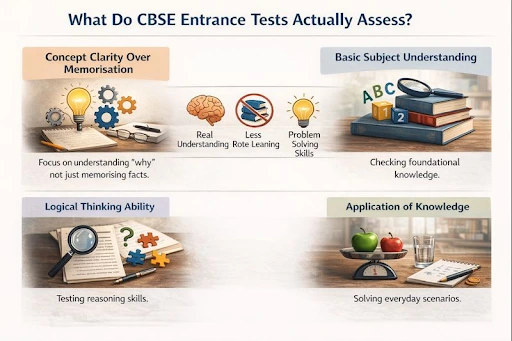
CBSE entrance tests focus on concept clarity, logical thinking, and basic understanding rather than rote memorisation. The goal is to understand how a child thinks and applies knowledge.
Concept clarity over memorisation
Instead of testing definitions, schools assess whether a child understands why concepts work. This reflects the modern CBSE entrance test pattern, which prioritises depth of learning.
Benefits of this approach:
- Encourages genuine understanding
- Reduces dependence on memorisation
- Builds problem-solving ability
Basic subject understanding
Questions are usually based on the school admission test syllabus of the previous class. This helps schools confirm whether foundational learning is strong.
The focus remains on:
- Familiarity with key topics
- Comfort with basic concepts
- Ability to recall and apply learning
Logical thinking ability
Logical reasoning questions assess analytical skills and thinking patterns. These questions help schools understand how a child approaches unfamiliar problems.
Application of knowledge in simple situations
Students may be asked to apply knowledge in everyday scenarios. This checks understanding rather than speed or perfection.
Which Subjects Are Commonly Included in CBSE Entrance Tests?
Most CBSE entrance tests assess English, Mathematics, reasoning, and subject basics relevant to the applied class. This balanced approach ensures holistic assessment.
Let’s know in detail about what criteria it’s been assessed against:
- English language and comprehension skills
English sections are similar to an English aptitude test for school admission, focusing on:
- Reading comprehension
- Basic grammar
- Vocabulary appropriate to age
- Mathematics fundamentals
Mathematics sections resemble a maths aptitude test for school admission, testing:
- Number sense
- Basic operations
- Simple problem-solving
- Logical reasoning and aptitude
Age-appropriate reasoning questions for the school entrance exam evaluate thinking skills rather than academic knowledge.
Subject basics for higher classes
For senior classes, subject familiarity is checked to ensure students can handle the academic demands of higher grades.
How Do Entrance Tests Differ by Class Level?
CBSE entrance tests vary by age group, with expectations increasing gradually across academic stages. This ensures fairness and comfort.
Primary classes focus on basic skills
At the primary level, schools assess:
- Reading and writing comfort
- Basic numeracy
- Attention and understanding
Middle classes test understanding and continuity
For the middle classes, the focus shifts to:
- Conceptual understanding
- Learning consistency
- Ability to connect topics
Senior classes check subject strength and clarity
Students appearing for the Class 11 admission test CBSE are assessed based on subject readiness aligned with their chosen stream.
| Class Level | What Is Assessed | Focus Area |
| Primary | Basic skills | Foundation |
| Middle | Understanding | Continuity |
| Senior | Subject strength | Stream readiness |
Now, understand what happens during the interview or interaction round:
The interaction round helps schools assess confidence, behaviour, and parent–school alignment.
It complements the written test.
- Student confidence and communication
Schools observe how comfortably a student communicates thoughts and responds to questions.
- Behaviour, attitude, and comfort level
This helps assess adaptability, classroom behaviour, and emotional readiness.
- Parent interaction and expectations
Parents may be asked school admission interview questions to understand:
- Academic expectations
- Support systems at home
- Alignment with school values
What Are the Most Common Myths About CBSE Entrance Tests?
Many parents fear entrance tests more than children do, mostly because of myths.
Let’s clear them up.
| Common Myth | What Actually Happens |
| Only toppers get selected | Schools focus on readiness and learning fit, not rank or high scores. |
| Coaching is compulsory | Entrance tests are based on regular school learning, not coaching material. |
| The test is extremely difficult | Most tests are age-appropriate, balanced, and designed to reduce stress. |
How Can Parents Help Children Prepare for Entrance Tests?
Parents play a vital role in shaping how children experience the preparation for entrance tests.
When the approach is calm and supportive, children feel more confident and less pressured.
Focusing on core concepts
Entrance tests are designed to assess whether basic ideas from the previous class are clear. Revising these fundamentals helps children feel prepared without overwhelming them.
Parents can support this by:
- Revisiting key topics from textbooks
- Encouraging understanding instead of memorisation
- Clarifying doubts gently rather than correcting harshly
Practising regularly without pressure
Short and consistent practice sessions help children stay familiar with concepts without feeling exhausted. This approach supports children in understanding how to prepare for the CBSE school entrance exam in a balanced way.
Helpful practices include:
- Keeping study sessions short and focused
- Allowing breaks to avoid mental fatigue
- Avoiding comparisons with other children
Encouraging calm confidence
Confidence grows when children feel supported rather than judged. Positive reinforcement reassures them that effort matters more than perfection.
Parents can encourage confidence by:
- Appreciating small improvements
- Reassuring children that mistakes are part of learning
- Maintaining a calm attitude around tests and results
What Do Schools Look for Beyond Marks?
Schools value attitude, consistency, and classroom readiness alongside academic ability.
This approach is followed by institutions like Bodhi Bhavans.
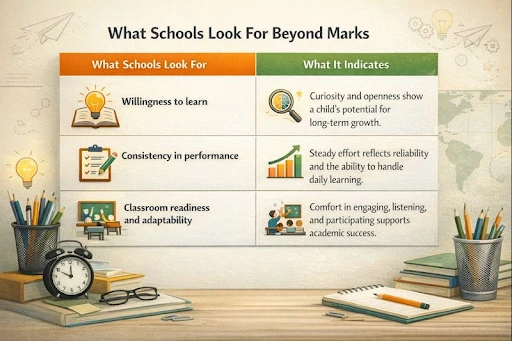
For parents evaluating a CBSE school in Kolkata, these factors often influence long-term success more than entrance marks.
Final Takeaway for CBSE Admissions 2026
Entrance tests are tools for understanding, not judgment. When parents focus on readiness rather than results, children experience less stress and greater confidence. The right school fit supports academic growth and emotional well-being.
If you are planning admissions for 2026 and considering a CBSE school in Kolkata, take time to understand the process. Visit Bodhi Bhavans or call at +919830062937 for admission-related queries today.
People Also Ask (FAQs)
- Do CBSE entrance tests focus only on marks?
No, they assess readiness, concept clarity, and learning pace. - Is coaching necessary for CBSE entrance tests?
No, regular schooling and understanding the concepts are sufficient. - What subjects are included in CBSE entrance exams?
English, Mathematics, Reasoning, and the basics of class-specific subjects. - How important is the interview round?
It helps schools understand confidence and expectations. - How can parents reduce entrance test stress?
By focusing on basics, offering reassurance, and avoiding pressure.