
Switching from Bengali to English medium is a big shift, and it’s completely normal for your child to feel a little lost in the process.
The textbook’s writings are in English, the teachers are communicating in English, but the child’s inner monologue is still in Bengali. This mismatch leads to the common language problem in English medium school settings, where ‘I know it’ never quite becomes ‘I can say it.’
If you’ve chosen a top-tier school like Bodhi Bhavans, a CBSE school in Kolkata, you know the standards are high. But how do you bridge the gap between “Aami jani” and “I know”? Let’s break it down through this blog.
The Challenges of English-Medium Education in Kolkata
In a city where the Bengali language is deeply rooted in daily life, transitioning to an English-medium school can feel overwhelming.
While the curriculum is in English, students often face a disconnect in their social interactions, as friendships and casual conversations still thrive in Bengali. This creates unique challenges for children trying to adapt to the new environment.
Bridging the Gap Between Classroom English and Social Conversations
You know what the Social English gap concept is?
Social English gap-filling exercises focus on practical, everyday conversational skills rather than formal grammar, covering topics like greetings, small talk, making arrangements, and common idioms.
Your child may ace an essay on “The Solar System,” but struggle with the English used in a football match. This “Social English” gap often becomes the first real challenge for kids trying to fit in.
Why Your Child Understands but Struggles to Express
This isn’t about your child’s intelligence; it is a classic language problem in an English-medium school that many students face. It’s more like a “processing bottleneck” than a learning issue.
Here’s how it happens:
- Input: The teacher explains a concept in English.
- Internal Translation: Your child processes the information by translating it into Bengali.
- Thought: Brilliant ideas are formed in Bengali.
- Output: When they try to express it in English, they struggle with the right words and structure.
What Problems Parents Notice First (And What They Actually Mean)
| What You See | What is Actually Happening |
| The “Silent” Phase | High “Affective Filter”, the child is terrified of being mocked for an accent. |
| Grammar “Salad” | Mixing Bengali and English rules (Interlanguage). It’s a sign of a growing brain! |
| Reading but not Comprehending | “Word Calling.” They can make the sounds but the meaning isn’t “locking” in. |
| Low Confidence | Your child feels their “smartness” is tied to their English. It shouldn’t be. |
Silence in Class, Low Confidence, and “I Know It, But I Can’t Say It”
When a child stops participating, they are protecting themselves. A child from a Bengali-medium background feels like they are running a race with their shoelaces tied. They know the answer, but the “delivery” feels too risky.
Reading Okay, Writing Weak: Why That Mismatch Happens
Your child has the knowledge of the bricks (words) but no cement (grammar/connectors).
Reading is a passive recognition skill. Writing is an active construction.
If your child can read the textbook but can’t write a summary, they lack “Sentence Architecture.” Get admission for your child at Bodhi Bhavans, a CBSE School in Kolkata, for proper guidance.
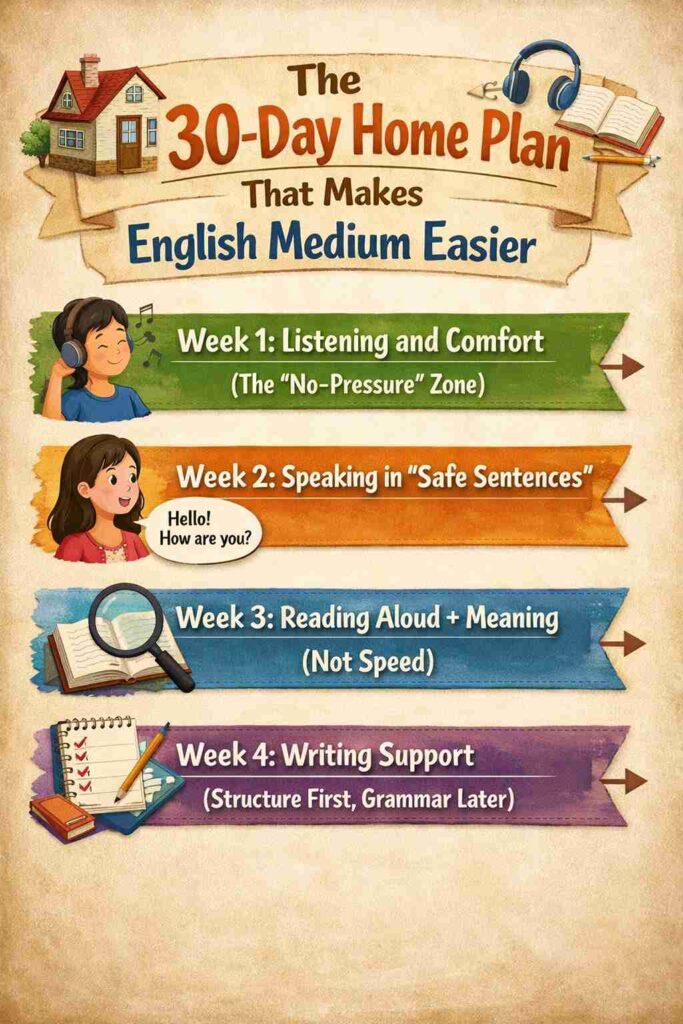
The 30-Day Home Plan That Makes English Medium Easier
You don’t need to be a linguist to help. You just need a system.
Week 1: Listening and Comfort (The “No-Pressure” Zone)
Stop forcing them to speak. Instead, flood the environment with “Comprehensible Input.” Watch English cartoons with English subtitles. Listen to podcasts for kids. Let them hear the language’s music before they have to perform it.
Week 2: Speaking in “Safe Sentences”
Teach them 10 “Survival Phrases” :
- “Could you please repeat that?”
- “I have a doubt about…”
- “May I join the game?”
How to improve English speaking for school students starts with these small, repeatable wins.
Week 3: Reading Aloud + Meaning (Not Speed)
Have them read 3 sentences. Ask them to tell you what it means in Bengali. If they can’t, they are just “making sounds.” Bridge the meaning first.
Week 4: Writing Support (Structure First, Grammar Later)
Encourage them to write “Bad English.” If they write “I am happy to go to school,” don’t correct the “to.” Celebrate the communication. Fluency comes from the habit of writing, not the correction of it.
What Parents Should Stop Doing
- Correcting every mistake: If you interrupt their story to fix a verb, they will stop telling you stories.
- Comparing with Cousins: “Look at how well Rahul speaks!” is the fastest way to make your child hate English.
- The “English-Only” Home Rule: This makes English feel like a punishment. Keep home a “Bilingual Haven.”
Simple Daily Activities That Improve English Faster Than Extra Homework
| Activity | Duration | Purpose |
| The 10-Minute Picture Talk | 10 Mins | Describe a photo in 5 sentences. |
| The One-Cartoon Method | 20 Mins | Watch the same episode 5 times to absorb sentence patterns. |
| Micro-Journaling | 5 Mins | Write 3 things that happened today. No grammar checks! |
How to Communicate with Teachers the Right Way
Ever felt unsure about how to approach your child’s teacher? It’s natural to want to be involved without overstepping.
Effective communication is all about being clear, respectful, and supportive. By asking the right questions and listening attentively, you can build a positive rapport with teachers while showing you’re invested in your child’s progress.
5 Questions for your next PTM
- “Is my child’s silence due to a lack of understanding or a lack of confidence?”
- “Which subject’s terminology (Science/Math/SST) is hitting them the hardest?”
- “What are the specific writing formats I should focus on at home?”
- “Are there library books you recommend for their specific level?”
Mastering the Transition: A Parent’s Guide to English Medium Education”
Transitioning from Bengali to English medium can be challenging for children, but with the right approach, parents can make it easier. This guide offers a 30-day plan to improve language skills, build confidence, and bridge the gap between social and academic English. It also provides tips for effective communication with teachers and daily activities to support your child’s growth in an English-medium environment.
For more information about admissions, contact Bodhi Bhavans, a leading CBSE school in Kolkata, today.
People Also Ask
How long does it take for a child to adjust to the English medium?
Usually, 6–12 months for “Social English” and 2–5 years for “Academic English” (the ability to write complex reports).
Should we speak only English at home?
No. Research shows that being strong in your mother tongue (Bengali) actually helps you learn a second language better. Keep the emotional connection to Bengali alive.
Is CBSE or ICSE better for English improvement in Kolkata?
ICSE schools in Kolkata are known for a stronger focus on literature, while CBSE schools in Kolkata emphasise functional, communicative English. Both work, provided the home support is consistent.
How can I help if I’m not confident in English myself?
Be a “Co-Learner.” Tell your child, “Let’s find the meaning of this word together.” Your effort shows them that it’s okay to be a beginner.